
Key Takeaways
- Judge every channel by cost per signed case, not cost per lead. Legal search averages $131.63 per lead against $70.11 cross-industry.
- Google Search and Local Services Ads capture expressed intent; Meta and remarketing reach people earlier. Budget and measure them separately.
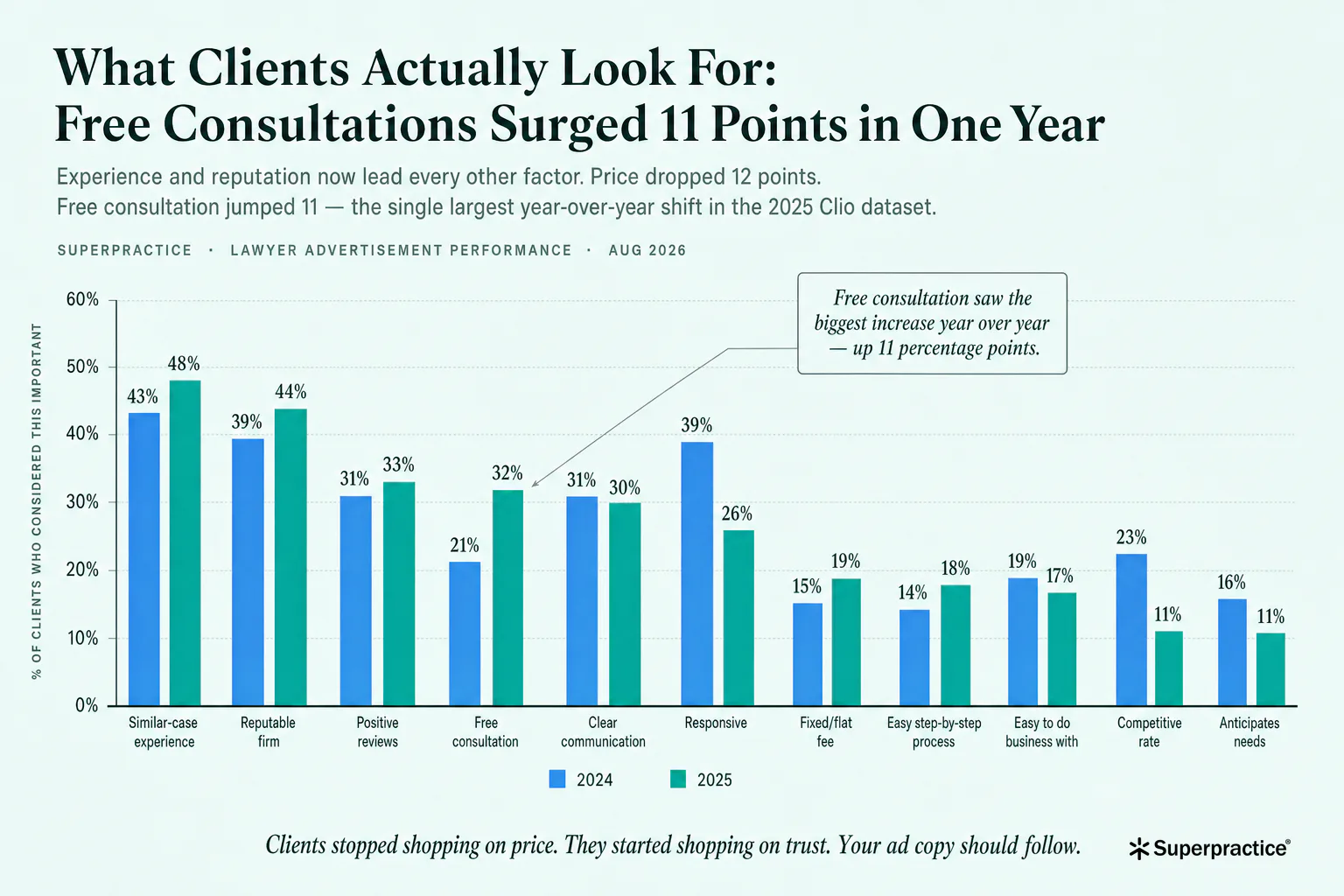
- Clients prioritize experience with similar cases and value a free consultation, so lead with both in ad copy and on landing pages.
- Google Ads no longer supports first-click attribution. Compare last-click against data-driven, and import signed-case outcomes as offline conversions.
- Intake is part of ad performance: Clio's secret-shopper research found 67% of firms never responded to email inquiries.
Written by Superpractice Editorial Team.
Attorneys and legal services carry the highest costs in paid search, . At those prices, a lawyer advertisement that generates clicks but no traceable retainers is a leak, not a marketing program. Most firms cannot name which campaign signed last month's cases, an infrastructure problem, not a budget problem. Firms must still follow their own state bar's advertising rules, which vary by jurisdiction.
Why Digital Channels Have Replaced Traditional Lawyer Advertising
Digital channels carry the measurable acquisition workload because they capture demand as it exists and record what happened next. Television builds brands but rarely tells you which spot produced a retainer. Clio's 2025 Legal Trends Report found 26% of consumers who recently hired a lawyer used internet search to find them, while 48% came through referrals. Referrals do not bypass digital, research summarized by CallRail found 46% of referred people still visited the firm's website and checked review sites first, which is why search presence and paid visibility work together.

Television Built Legal Brands While Search Captures Intent as It Happens
Isaacs Personal Injury Lawyers, Mike Morse Law Firm, Harris Personal Injury Lawyers, and George Sink Injury Lawyers all became regionally famous on TV. But Bloomberg Law reported that Darryl Isaacs spent $90,000 on local Super Bowl airtime plus six figures on production while acknowledging he could not say the commercials directly generated substantial new business. Awareness spend and intent-capture spend carry different measurement standards.
Legal Keywords Are the Most Expensive in Paid Search
Legal tops LocaliQ's benchmark dataset for both cost per click and cost per lead. Average cost per lead across industries declined for the first time in five years to $66.69, yet legal remained the most expensive vertical at $131.63. When a click costs nine dollars, an untracked conversion is a direct loss, the root cause of most law firm PPC waste.
Google Search and Local Services Ads Are Where Signed Cases Come From
Google Search Ads and Local Services Ads both intercept active searchers but price and qualify traffic differently. Legal benchmarks show an average cost per click of $9.21, an average click-through rate of 4.76%, click-to-lead conversion of 5.55%, and an average cost per lead of $131.63. Those are lead figures, not retained-client figures, and the gap is where most ad budgets for lawyers disappear.

Channel | Cost model | Best for
Google Search Ads | Per click | Specific, high-intent practice-area queries
Local Services Ads | Per contact | Local practices with strong review volume
Meta prospecting | Per impression | Awareness ahead of expressed need
Remarketing | Per impression or click | Recapturing prior site visitors
Practice area moves these numbers more than any other variable. Foundry's 2026 legal benchmarks put personal injury cost per signed case between $2,500 and $12,000 against average case values above $15,000, while bankruptcy campaigns convert at roughly 13.6% with cost per lead near $82. A family law or employment practice should never be held to a personal injury firm's target.
Google Search Ads Reward Tight Keyword Targeting
Broad targeting triggers irrelevant queries unless controlled with weekly search-term review and an aggressive negative keyword list, a firm bidding on "lawyer" pays legal rates for people researching law school. Build tightly themed ad groups by practice area, mirror the query in the headline, and send the click to a page built for it. Daily Google Ads auditing catches waste before it compounds.
Local Services Ads Charge Per Contact Instead of Per Click
Google's documentation explains that Local Services Ads charge when a prospective client gets in touch, a call, message, or booking through the ad, and that rank comes from an auction combining bid with profile quality signals including review rating, review volume, responsiveness, and completed verification. Paying per contact does not mean every contact is qualified, Google applies automated lead-quality review, with some credits issued within 24 hours and most within 30 days, though credits are unavailable in certain verticals. Complete verification early, since review-driven rank in Local Services Ads compounds.
Meta and Social Platforms Reach Prospects Before They Know They Need a Lawyer
Meta places a lawyer advertisement in front of audiences defined by behavior and first-party data rather than expressed intent, making it a fit for awareness and retargeting rather than same-day case capture. The ABA's 2024 Legal Technology Survey reports 80% of firms maintain a social presence, led by LinkedIn at 78% and Facebook at 53%. Meta's Advantage+ system treats interests, demographics, Custom Audiences, and Lookalike Audiences as signals it may expand beyond, so precise audience control is limited.

Meta Works When the Creative Earns Attention on Its Own
Social ads interrupt something else, so the creative carries the entire burden. Meta's Conversions API can send offline outcomes back into the platform, so the optimization event should be a qualified consultation or signed engagement, not a raw lead form. Before uploading client lists for Custom or Lookalike Audiences, run confidentiality, consent, and state-rule review, Meta requires lawful rights and permissions, and legal client data is sensitive.
Remarketing Recaptures Visitors Who Did Not Call the First Time
Meta supports retargeting from pixel activity and CRM lists, so you can segment general visitors, practice-area visitors, and consultation-page visitors and serve each different creative, the 7-11-4 rule in practice, roughly seven hours of content across eleven touchpoints and four media types before someone commits. Run remarketing as its own campaign with its own budget and conversion tracking, lumping it into prospecting hides which side of the funnel is producing.
What Separates a Lawyer Advertisement That Converts from One That Just Gets Clicked
The ad earns the click. The landing page and intake response earn the case. Clio's 2025 consumer research identified what clients weigh, including reputation at 44% and positive reviews at 33%, alongside experience in similar cases and the availability of a free consultation. Nothing in that list is about years in practice.
Lead With Relevant Experience and a Clear Next Step
Credential-stacking headlines about decades of practice compete with everything else in the auction. Copy built around similar-case experience, verifiable reputation, and a free consultation maps to what clients say they look for. Avoid guaranteed-outcome language, and treat emotional versus credential-led copy as an A/B test judged by signed cases, not click-through rate.
The Landing Page Is Where Most Legal Ad Spend Dies
A homepage asks the visitor to navigate, a dedicated page asks for one action. Give each campaign a single offer, practice-specific proof, mobile load speed, and one call to action. Clio's 2025 solo and small firm research found conversion from prospect to retained client improved 10% with e-signatures, 7% with text messaging, and up to 5% with online intake forms, real money against a $131.63 cost per lead. Responsiveness matters more, Clio's secret-shopper study found 67% of firms never answered email inquiries and 48% could not be reached by phone.
Without Attribution Infrastructure, a Lawyer Advertisement Is an Expense Not an Investment
Clicks and form fills are activity, a signed engagement is an outcome. The measurement hierarchy runs impression, click, inquiry, qualified consultation, signed engagement, attributable revenue, and most firms stop reporting at step three. ABA TechReport-based analyses show only 47% to 49% of firms have a formal annual marketing budget, which is also why advertising a law firm costs more than it should.

Call Tracking and CRM Integration Are the Minimum Viable Stack
Phone calls remain the primary legal conversion path: 68% of consumers contact a firm by phone and 42% retain the first lawyer who makes a good impression, per CallRail's summary of consumer research. Response inside five minutes materially raises retention odds. Google's website call tracking uses dynamic number insertion to identify which keyword, ad, ad group, and campaign produced a call, but only your CRM knows whether the caller retained. Google's call conversion import workflow is explicit, record the outcome in a CRM, match it to the originating ad, then bid toward calls that lead to actual business.
Last-Click and Data-Driven Attribution Produce Different Decisions
Google Ads no longer supports first-click, linear, time-decay, or position-based models. The remaining choices are last-click and data-driven, with data-driven the default for most conversion actions. Google recommends at least 200 conversions and 2,000 ad interactions in 30 days for precise modeling, so smaller firms should read the data cautiously. Cross-platform paths require CRM stitching with persistent campaign identifiers, because Google Ads does not resolve a Meta impression, a Google click, and a direct call into one identity. Create CRM stages for lead, qualified lead, consultation completed, engagement sent, and engagement signed, and let only the last stages guide value-based bidding.
How Superpractice Runs the Full Path From Ad Impression to SignedEngagement
Agencies with access only to ad platforms can optimize toward leads, not signed cases, unless the firm feeds intake and retainer data back into the system. That is the incentive gap to interrogate before signing anything.
Ask Any Agency for Cost Per Signed Case
If the answer is a cost-per-lead figure, the vendor is optimizing volume while you carry the cost of unqualified intake. Request the report showing which campaign, keyword, and ad produced each retained matter, the standard any law firm advertising strategy should be held to.
Superpractice Connects Ad Spend to Signed Retainers
Superpractice operates as three connected layers, Marketing, Conversion, and Intelligence, so ads, calls, meetings, matters, intake, and attribution run from a shared system, mapping to the Four-Pillar approach of search visibility, paid acquisition, reputation, and conversion optimization. Its acquisition offering covers Google Ads, Local Services Ads, Facebook, Instagram, LinkedIn, and retargeting under one attribution layer, and the company states its attribution product stitches touchpoints across 48 channels and connects channel, campaign, ad, call, text, and meeting data to signed retainers. Insist on that loop, whoever you hire.
Frequently Asked Questions About Lawyer Advertisements
What is the best way to advertise a law firm online?
Pair Google Search and eligible Local Services Ads with remarketing, a practice-specific landing page, and immediate intake follow-up, routing every call and form into a CRM. Our guide to advertising a law firm walks through the build order.
What kind of advertising do lawyers most commonly use?
Websites, referrals, and online reviews, according to Clio's 2025 Legal Trends Report. For paid acquisition, Google Search and Local Services Ads dominate.
Why was it illegal for lawyers to advertise?
Professional disciplinary rules, not criminal statutes, broadly barred lawyer advertising until Bates v. State Bar of Arizona, 433 U.S. 350 (June 27, 1977), held that truthful price advertising for routine legal services is protected commercial speech. States still regulate misleading advertising and certain solicitation.
What is the best slogan for a lawyer?
There is no universally best slogan, the formula that performs combines a specific client problem, a credible benefit, and a low-friction next step. Keep claims truthful under ABA Model Rule 7.1 and ABA Model Rule 7.2 as adopted in your jurisdiction.
Every Lawyer Advertisement Should Be Judged by One Standard
Legal paid search is the most expensive category in LocaliQ's benchmark data, with cost per lead at $131.63 before anyone signs anything. A firm that cannot measure cost per signed case is running an expense line, not a marketing program. The firms that win close the attribution loop, treat intake as part of ad performance, and optimize the full path rather than the top of it. Superpractice runs that entire path, connecting each ad impression to a verifiable outcome through campaign management, intake integration, and closed-loop attribution. If your reporting cannot tell you which advertisements signed last month's cases, book a demo and see what full attribution shows.
Keep Breaking the Mold,
Superpractice Editorial Team Superpractice