Your law firm’s phone isn’t ringing enough. You’re watching potential clients slip away to competitors who seem to pop up everywhere online, while your expertise remains invisible. A strong online presence is essential for a law firm to attract clients seeking legal assistance. Meanwhile, you’re burning through marketing budget on tactics that feel more like throwing darts in the dark – cold calls that go nowhere, expensive directory listings that generate tire-kickers, and networking events that eat up billable hours without producing quality leads.
Here’s the uncomfortable truth: while you’re debating whether to invest in systematic client acquisition, your competitors are already capturing the high-intent prospects searching for legal help right now. In 2023, inbound leads cost 62% less than outbound marketing leads, making inbound marketing one of the most cost-effective strategies for law firms seeking sustainable client acquisition. Your ideal clients are actively searching online for legal help, and they’re finding your competitors instead.
This isn’t just about getting more leads. It’s about building a client acquisition system that attracts clients who are already seeking your services, trust your expertise before they even call, convert at higher rates, and become long-term advocates for your firm. This comprehensive guide will show you exactly how to build an inbound marketing system that transforms your practice from a hidden gem to a go-to authority in your market.
What is Law Firm Inbound Marketing?
Law firm inbound marketing is a client-acquisition strategy that focuses on attracting qualified leads through valuable, educational, and trust-building content rather than interrupting them with unsolicited advertising. This strategy focuses on creating resources that help high-intent prospects find your law firm when they are actively seeking legal advice or representation.
The core principle operates on a “pull” rather than “push” approach. Instead of cold calling or sending direct mail campaigns, your law firm creates informative blog posts, educational videos, and helpful guides that naturally draw prospective clients to your practice. This method positions your law firm as a knowledgeable authority while nurturing leads through helpful communication and consistent brand presence. Done-for-you client acquisition systems are customized to each law firm’s needs, ensuring that every campaign is specifically designed to address the unique goals and challenges of your law firm’s practice.
Over time, people who consume your content begin to view your attorneys as trusted advisors. Importantly, inbound marketing tactics can be tailored to any practice area – whether it’s a personal injury firm writing about insurance claims, a patent law firm publishing guides on the USPTO application process, or a corporate attorney sharing insights for in-house counsel at tech startups- by thoroughly understanding the law firm’s needs when developing content and strategies.
However, most inbound marketing discussions miss a critical point: modern legal consumers require 7 hours of content across 11 touchpoints in 4 locations before converting, what we call the 7-11-4 Rule. This means sporadic blog posts and occasional social media updates can never generate predictable pipelines. Only systematic, multi-channel client acquisition systems can bridge this ‘Trust Deficit’ and consistently convert prospects into retained clients.
Why Inbound Marketing Works for Legal Services
The legal industry faces unique challenges that make inbound marketing particularly effective. Strict ethical and bar regulations often limit aggressive or direct solicitation, making inbound marketing’s non-intrusive, informative approach both compliant and robust for client acquisition.
For example, ABA Model Rule 7.3 prohibits lawyers from soliciting professional employment via in-person or real-time contact for pecuniary gain, and the Bar Council of India’s Rule 36 similarly forbids direct advertising by lawyers.
Inbound marketing also aligns with how modern clients search for lawyers. Understanding this search behavior is critical: modern legal consumers require 7 hours of content across 11 touchpoints in 4 locations before making a decision.
This “7-11-4 Rule” explains why single-channel marketing approaches and sporadic content efforts consistently fail to generate predictable pipelines. More than one-third of potential clients now begin their attorney search online, and a recent consumer study found that most people use Google as their primary tool to research attorneys. Most clients use search engines to find law firms online, so if your firm isn’t producing online content and ranking in search results, you risk invisibility during that crucial research phase.
According to industry statistics, inbound marketing efforts generate leads at 62% less cost than traditional outbound methods. This cost advantage proves crucial for law firms seeking to cultivate sustainable client relationships within budget constraints or limited marketing resources. Reflecting this, many firms have been shifting resources to inbound. For example, nearly 65% of law firms’ marketing spend is now devoted to online/digital marketing, with a strong focus on SEO, content creation, and social media to attract qualified leads and grow their practices.
Perhaps most importantly, the relationship-building approach inherent in inbound marketing nurtures trust throughout the potential client’s legal journey. By consistently providing value, whether through a blog that addresses common questions or a free webinar that clarifies a complex legal process, your firm establishes credibility long before any consultation takes place. Content marketing has been proven to build credibility effectively – for instance, 88% of marketers report achieving their goals of creating awareness and building trust through content initiatives.
The reality? While you’re contemplating strategy, your competitors are already implementing done-for-you client acquisition systems and capturing the market share you’re leaving on the table. Procrastination isn’t billable.
The Four Stages of Inbound Marketing for Law Firms
Successful inbound marketing for law firms follows a strategic four-stage process that transforms website visitors into loyal clients and advocates. Each stage – Attract, Convert, Close, and Delight – is critical in moving a stranger from awareness to becoming not only a client but a promoter of your firm.
Stage 1: Attract
The attract stage involves bringing prospective clients to your law firm’s website through SEO-optimized content, informative blog posts, and a strategic social media presence. Your goal is to become discoverable and relevant when internet users search for legal solutions or information related to your practice areas.
However, most law firms make a critical mistake at the Attract stage: they focus exclusively on organic content and SEO, then wonder why it takes 6-12 months to generate meaningful leads. This is why The Superpractice Method structures inbound marketing differently, always starting with Pillar 1 (High-Intent Lead Capture through Google Search Ads and Local Services Ads) to generate immediate qualified leads, while simultaneously building the long-term content infrastructure that attracts organic traffic over time. You don’t wait months for ROI; you get consultations within days while creating sustainable growth.
Key tactics include creating content that addresses common legal questions in your practice area, optimizing your law firm website for local search terms, and maintaining an active social media presence that showcases your expertise. For example, a personal injury law firm might create blog posts about “What to do immediately after a car accident” or “Understanding workers’ compensation claims.”
Search engine optimization (SEO) is a linchpin of the Attract stage. You’ll want to conduct keyword research to identify the exact terms prospective clients use (e.g., “family lawyer near me” or “how to file a patent application”). Then incorporate those keywords naturally into high-quality content. Optimizing for local search is especially important for attorneys – a majority of legal consumers prefer a law firm that is within a 30-minute drive of their location.
Additionally, creating dedicated landing pages for specific campaigns or practice areas can significantly improve conversion rates and make it easier to track performance metrics, such as bounce rates and goal completions, using analytics tools.
Stage 2: Convert
Converting website visitors into leads requires strategically placed calls to action, well-designed contact forms, and valuable offers, such as downloadable legal guides or checklists. Optimizing your law firm’s website to maximize conversions is essential, as it ensures that these elements are effective in capturing new client opportunities. The focus shifts to capturing contact information so your law firm can continue nurturing the relationship.
Effective conversion tactics include offering free consultations (a time-tested strategy in legal marketing) and creating valuable downloadable resources as lead magnets. For instance, a family law practice might offer a free e-book on “Preparing for a Child Custody Hearing” in exchange for an email address, or an immigration attorney might provide an “Immigration Eligibility Self-Assessment” tool behind a contact form.
It’s worth noting that many law firms do offer a no-cost initial consultation as an incentive. According to a 2024 Legal Trends Report, 49% of firms offer a free initial case review (while 51% charge a consultation fee). If your practice can accommodate it, a free consult is often a highly compelling CTA that will boost conversions.
Stage 3: Close
The close stage transforms leads into paying clients through streamlined processes and personalized follow-up. This often involves using CRM tools to automate client intake, schedule consultations, and deliver a seamless onboarding experience.
Prompt and professional follow-up is absolutely vital: research indicates that 42% of law firms take an average of 3 or more days to respond to a message from a new potential client. This delay can be disastrous when clients expect quick help. Even more startling, 35% of the time, phone calls from prospective clients go unanswered.
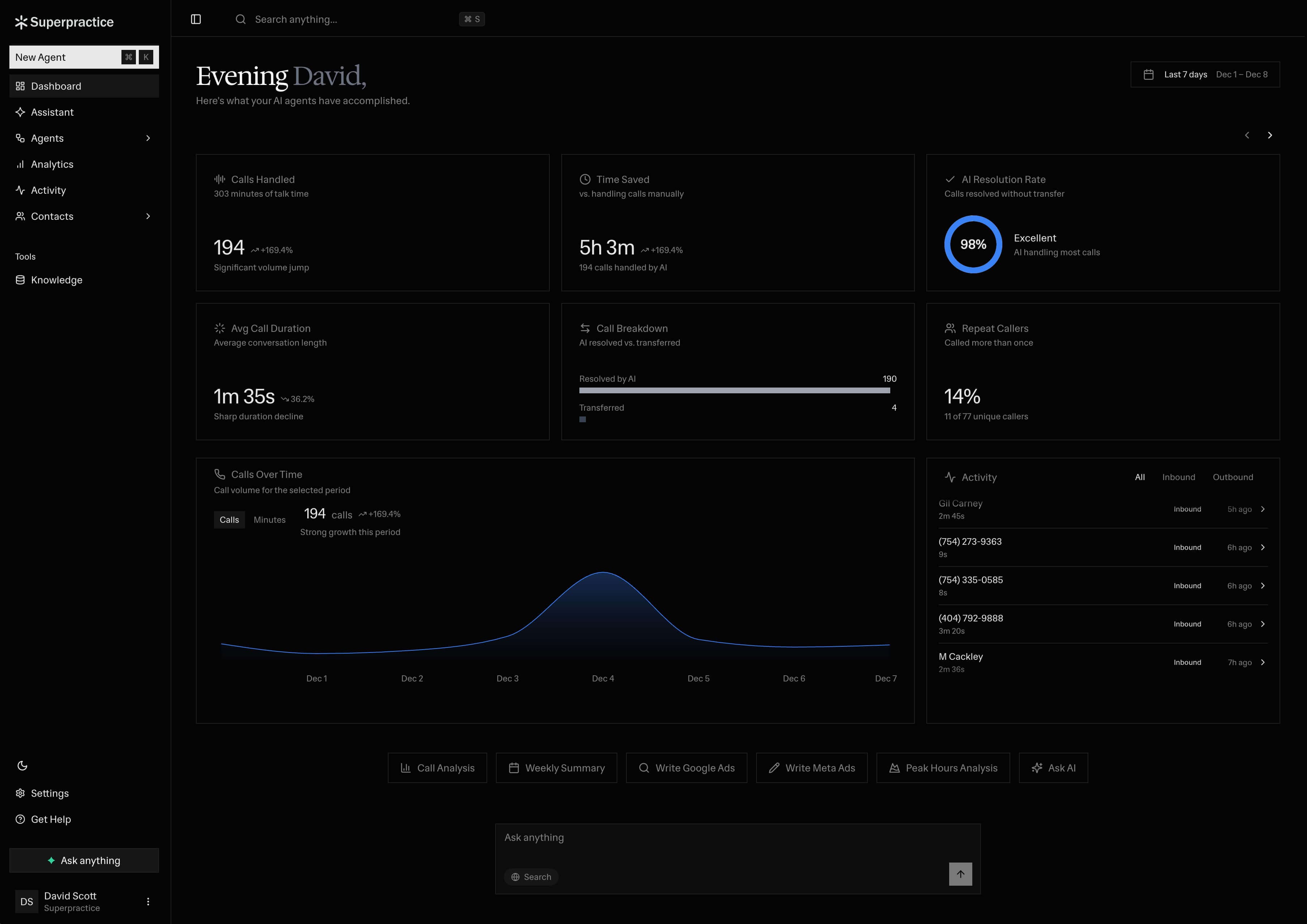
This is where 24/7 AI-powered response systems prove invaluable, where Pillar 4 (Conversion Infrastructure) becomes critical. Competitors lose 35% of calls to voicemail and take 3+ days to respond to web inquiries. Superpractice AI Agents provide 24/7 call handling, website chat engagement, intake qualification, and automated scheduling.
These aren’t generic chatbots that frustrate prospects; they are sophisticated AI agents that provide immediate, context-aware responses, qualify leads based on your criteria, and book consultations directly into your calendar. You never miss an opportunity because someone called after hours or submitted a contact form at 11 PM. Every lead your inbound marketing generates receives immediate professional attention, so you can focus on practicing law.
Stage 4: Delight
Following engagement, the focus shifts to maintaining communication with existing clients, sharing relevant legal updates, and encouraging referrals and repeat business. Delighting your clients increases the likelihood they’ll leave a positive review on Google, Avvo, or Yelp, which in turn feeds back into the Attract stage for new clients. Showcasing satisfied clients through testimonials and case studies also builds trust and credibility, helping to attract new business.
In financial terms, investing in client delight yields one of the best returns: retaining a happy client (or receiving a referral from one) saves significant costs associated with client acquisition. For law firm clients, retention is substantial for long-term success. Studies have shown that acquiring a new client can cost five to 25 times as much as retaining an existing one.
Essential Inbound Marketing Tactics for Legal Practices
Effective inbound marketing for law firms requires combining multiple strategies to attract qualified leads, build trust, and generate new client opportunities. Sharing valuable information, such as high-quality legal resources and insights, is essential to attract and engage clients. The most successful law firms implement a comprehensive approach that includes content marketing, search engine optimization, video marketing, social media engagement, and email nurturing campaigns. Including relevant links in your content and email campaigns can further drive engagement and conversions by directing recipients to valuable resources.
Content Marketing and Legal Blogging
Content marketing forms the foundation of successful inbound marketing efforts for law firms. Creating educational blog posts that address common legal questions in your practice areas helps establish your firm as a trusted authority while improving your search engine rankings. This is what we call the Legal Epiphany Engine – strategic content that makes prospects aware of legal issues they didn’t even know they had, creating demand rather than just capturing it.
Effective legal content marketing begins with thorough keyword and audience research. You need to understand what your potential clients are searching for online. Tools like Google’s Keyword Planner or legal-specific SEO tools can help identify common queries. For example, a divorce lawyer might find that people frequently search for phrases such as “How is child support calculated in [State]” or “Do I need a lawyer for an uncontested divorce?” Similarly, a personal injury lawyer could create specialized pages or blog posts targeting terms such as “What to do after a car accident” or “How to choose a personal injury lawyer,” which are highly searched for by individuals seeking injury-related legal assistance.
Best practices for legal blogging include writing in clear, plain language (avoiding excessive legal jargon), breaking up text with headings and bullet points for improved readability, and incorporating real-world examples or case studies (anonymized to protect confidentiality) to effectively illustrate your points. In fact, content marketing is so effective at building credibility that a majority of law firm owners report incorporating content marketing into their digital strategy.
Beyond just attracting readers, legal content can directly translate into new clients. Analytics and surveys have shown tangible results from blogging. In one ABA survey, 29% of law firms with blogs reported that a client had retained their services, either directly or via referral, because of their blog content. For solos and small firms, the impact was even greater – 45% of solo practitioners said they’d gotten a client thanks to their blogging efforts.
Learn more about transforming your expertise into a 24/7 client magnet with our comprehensive guide: The Superpractice Method.
Search Engine Optimization (SEO) for Law Firms
SEO is critical for law firm marketing because most potential clients begin their legal services search on Google. Effective SEO strategies help your law firm appear when prospective clients search for relevant legal services in your geographic area. This is Pillar 1 of The Superpractice Method: High-Intent Lead Capture – positioning your firm where active seekers are already looking.
Local SEO strategies are crucial for law firms since legal services are typically sought within specific geographic areas. This means optimizing for location-based searches and ensuring your firm’s contact information and reviews are accurate and up to date. Key steps include claiming and optimizing your Google Business Profile, managing online reviews, and building local citations.
Many people rely on reviews as a proxy for quality; remember the statistic that 98% of consumers said they would read online reviews of an attorney before hiring. Local SEO also involves building local citations (mentions of your firm’s name, address, and phone number on directories and legal listings).
Technical SEO considerations shouldn’t be overlooked. Ensure your website loads quickly and is optimized for mobile devices. As of 2023, approximately 74% of law firm websites were reported to be mobile-friendly, which means roughly a quarter still aren’t, or the firm owners are unsure. Given that a large share of attorney searches occur on mobile devices, a responsive, fast mobile site is crucial.
Systematically dominate local search and build conversion-driving social proof: 5-Star Rank Catalyst.
Video Marketing for Legal Professionals
Video content is increasingly essential to law firm marketing efforts, offering opportunities to build personal connections and explain complex legal concepts in accessible formats. In a field often perceived as formal or opaque, video can humanize your attorneys and make legal information easier to digest. Notably, consumer behavior shows the rise of video: approximately 1 in 6 people searching for legal information online use videos as part of their research, with YouTube as the leading platform.
One common concern is the cost and production value of video. The good news is that high-quality video production is more accessible than ever. While professional videographers can add a polish, many attorneys start effectively with just a decent smartphone camera, a good microphone, and proper lighting. Authenticity matters more than glitzy production in most cases. A Wyzowl study found that 84% of people say they’ve been convinced to buy a product or service by watching a brand’s video.
Video content types that work well for law firms include attorney introduction videos, educational legal explainers, client testimonials (where permitted), and webinars or live Q&A sessions. Each serves different purposes in building trust and demonstrating expertise.
Social Media Marketing for Law Firms
Social media marketing for law firms requires striking a balance between engagement opportunities and ethical compliance requirements. According to the ABA’s 2023 Legal Tech Survey, 83% of law firms that maintain a social media presence use LinkedIn, and 57% use Facebook, with even higher LinkedIn usage (97%) among large firms. These social media sites, such as LinkedIn and Facebook, are commonly used for legal marketing to increase visibility and engagement. Furthermore, 81% of individual attorneys report participating on social media for professional purposes (again, LinkedIn is the most popular).
Different social media platforms serve various purposes in your overall client acquisition strategy. LinkedIn proves particularly valuable for building professional relationships and sharing thought leadership content. Facebook facilitates local community engagement and brand awareness, while Twitter enables the sharing of real-time legal commentary and industry insights.
No matter the platform, ethical compliance is paramount. Every post or interaction is subject to attorney advertising rules. Be cautious about confidentiality – never disclose client details on social media (even in a “hypothetical” that could be recognized). Be truthful and not misleading: don’t overstate your expertise or imply a guarantee of results.
Email Marketing and Newsletter Strategies
Email marketing remains one of the most effective channels for nurturing leads and maintaining relationships with past clients. While social media algorithms and search engine rankings can fluctuate, an email list is an asset you directly own – it allows you to communicate with an audience that has explicitly indicated interest in what your firm has to say. Regular email campaigns help keep your audience informed about legal updates and firm news, ensuring subscribers stay engaged and up to date.
Segmentation is a powerful email marketing practice that allows you to tailor content to different groups of subscribers. Not all your leads are interested in the same topics. If your firm has multiple practice areas or serves distinct client types, you can segment your list accordingly. The benefit is higher engagement – segmented email campaigns can generate up to 760% more revenue than non-segmented campaigns, as content is more precisely matched to readers’ interests.
Email marketing forms a critical component of Pillar 3 (Omnipresent Remarketing) in The Superpractice Method. Remember: prospects need 7 hours of content across 11 touchpoints in 4 locations before converting. Email ensures you maintain a consistent presence throughout their decision journey, keeping your firm top-of-mind across multiple touchpoints and preventing qualified leads from slipping away to competitors who respond faster or stay more visible.
In conclusion, email marketing might not have the flash of social media, but it’s a workhorse for inbound marketing. It’s one of the most effective ways to nurture long-term relationships. When done right, email marketing can yield one of the highest returns on investment. Some sources estimate an average of $42 in revenue per $1 spent on email marketing, owing to its low cost and high engagement when the audience is well-targeted.
Master systematic lead nurturing that converts prospects into retained clients: Follow-Up Mastery for Law Firms.
Business Development for Law Firms
Business development is at the heart of every successful law firm, and inbound marketing has become an essential driver of growth in today’s digital landscape. By consistently producing valuable content and engaging with qualified leads on social media platforms, law firms can position themselves as trusted authorities in their practice areas and generate a steady stream of high-intent prospects.
A strategic client acquisition system that leverages inbound marketing efforts, such as publishing informative blog posts, sharing legal updates on social media, and participating in online discussions, can significantly increase website traffic and attract more clients. For example, a personal injury law firm might use blog posts to explain the claims process or highlight recent case results, then amplify that content through targeted social media marketing. This approach not only educates potential clients but also builds credibility and trust, making it more likely that those individuals will reach out when they need legal services.
Social media platforms offer law firms a unique opportunity to connect with their target audience, showcase their expertise, and cultivate meaningful relationships. By sharing valuable content and engaging in conversations relevant to their practice areas, law firms can enhance their online reputation and visibility. Ultimately, investing in inbound marketing as part of your business development strategy helps your law firm generate qualified leads, expand its client base, and achieve sustainable growth.
Measuring Inbound Marketing Success for Law Firms
Measuring the effectiveness of your inbound marketing efforts requires tracking specific key performance indicators (KPIs) that align with your law firm’s business goals. Unlike traditional advertising, where results can be challenging to track, digital marketing provides detailed analytics that help you understand which strategies generate the best return on your marketing investment.
Key Performance Indicators for Legal Marketing
The most critical metrics for law firm inbound marketing include website traffic and engagement, leads generated, conversion rates, client acquisition numbers, and client lifetime value. Website traffic metrics help understand the effectiveness of your content marketing and SEO efforts. Track organic traffic growth, page views for your most important service pages, and time spent on site to gauge user engagement.
Conversion rates at each stage of your inbound marketing funnel reveal where prospects might be dropping off and where improvements could increase overall effectiveness. Monitor the percentage of website visitors who become leads, the number of leads who schedule consultations, and the rate of consultations that convert into new legal clients.
Calculate your potential return on investment from systematic client acquisition: Law Firm Marketing ROI Calculator.
Calculating Return on Investment
Calculating ROI for inbound marketing involves comparing the revenue (or projected lifetime value) generated by inbound-acquired clients against the costs of your marketing efforts. Costs include content creation, SEO tools or services, advertising spend (if any for promotion), and the time your staff spends on marketing (time is money).
A realistic timeline: most firms begin seeing meaningful results from inbound marketing within 3-6 months, with more significant growth occurring at the 6-12 month mark. This isn’t arbitrary – it reflects how long it typically takes to build up content and SEO presence (Google might take a few months to reward your content with high rankings), as well as the trust-building cycle of legal consumers.

These timeline expectations assume consistent execution, which is precisely where most firms fail. Between coordinating writers, managing SEO consultants, maintaining social media schedules, optimizing technical performance, and tracking analytics, inbound marketing becomes a full-time job.
This is why The Superpractice Method starts with Pillar 1 (High-Intent Lead Capture through Google Search Ads) to generate immediate qualified consultations and cash flow, while simultaneously building the content infrastructure that delivers compound returns over time. You don’t wait 6-12 months to see ROI; you get consultations within days while establishing long-term growth systems.
Analytics and Reporting
Monthly reporting should track trends in website traffic, lead generation, and client acquisition to identify what’s working and what needs adjustment. Use tools to gather data: Google Analytics provides a detailed look at user behavior (make sure you set up Goals in GA to track things like form submissions or clicks to your email/phone link, that way you can see conversion rates and even which traffic sources convert best).
One common mistake to avoid: failing to measure in the first place. Shockingly, about 26% of law firms do not track their leads at all, according to some surveys. Operating inbound marketing without tracking is like flying blind.
Leveraging Customer Feedback to Improve Inbound Marketing
Customer feedback is a powerful tool for law firms seeking to refine their client acquisition strategies and enhance client service. By actively seeking input from past clients, whether through email marketing surveys, follow-up calls, or online reviews, law firms can gain valuable insights into what their audience values most and identify areas for improvement.
Analyzing customer feedback enables law firms to craft blog posts that are more relevant and informative, addressing genuine client concerns and questions, ultimately providing a more effective service. For instance, if multiple clients express confusion about a particular legal process, your firm can develop a detailed blog post or FAQ to clarify it. This not only demonstrates responsiveness but also positions your law firm as attentive and client-focused, thereby enhancing your reputation and supporting client acquisition.
Incorporating feedback into your inbound marketing efforts also helps identify service gaps, improve client communication, and boost overall satisfaction. By making client feedback a cornerstone of your marketing strategies, your law firm can create a more personalized and practical approach, ultimately leading to stronger relationships, higher retention rates, and a steady influx of new client opportunities.
Optimize your first contact with prospects to dramatically increase conversion rates with the Intake Excellence Playbook.
Common Inbound Marketing Mistakes Law Firms Make
Even well-intentioned inbound marketing efforts can fall short when law firms make common strategic or tactical mistakes. Understanding these pitfalls helps avoid wasted marketing investment and accelerates progress toward your client acquisition goals.
Treating Inbound Marketing as a Standalone Tactic
The biggest mistake law firms make is treating inbound marketing as separate from their broader client-acquisition system. They publish blog posts without high-intent paid advertising to capture ready-to-hire prospects. They create content without omnipresent remarketing to keep their firm visible. They generate leads without a conversion infrastructure to ensure immediate response.
This is why The Superpractice Method structures inbound marketing (Pillar 2: Legal Epiphany Engine) within a sequential four-pillar system. Content marketing works exponentially better when combined with high-intent lead capture (Google Search Ads + LSA), multi-platform remarketing, and an AI-powered conversion infrastructure that ensures no opportunity slips away. Isolated blog posts can’t meet the 7-11-4 Rule; only a systematic, multi-channel implementation can.
Generic Content That Misses the Mark
One of the biggest mistakes is producing content that’s too broad, too superficial, or simply not aligned with what potential clients actually care about. Some firms churn out blog posts on generic legal topics (“What is personal injury law?”) that do little to differentiate the firm or engage readers.
The antidote is to be client-centric and specific. Instead of generic “Estate Planning Basics,” create targeted content like “How New 2024 Tax Laws Affect Estate Plans for Small Business Owners in [Your State]” – something timely and relevant to a subset of your clients.
Neglecting Local SEO Optimization
Many law firms make the mistake of focusing solely on general content and keywords while forgetting the enormous importance of local search. If you’re a lawyer, the vast majority of your clients will be searching for “[type of lawyer] in [City/Region]”. Local SEO basics that firms often overlook include consistent NAP (Name, Address, Phone) information across the web, accumulating Google reviews (and responding to them), and incorporating location-based keywords into site titles and content.
Inconsistent Content Publishing
Inbound marketing is a marathon, not a sprint. A common mistake is to start strong with content creation and then let it fizzle out gradually. Inconsistency can hurt your credibility (a visitor might wonder if you’re still active, or assume you’re not on top of current law if all your articles are years old). It also hurts your SEO; search algorithms tend to favor sites that are regularly updated with fresh content.
Weak Calls-to-Action
A prevalent mistake on law firm websites and content pieces is the lack of a clear next step for the reader. You might have fantastic articles that draw in visitors, but if those pages just end with nothing but the firm’s name, many readers will leave without taking any action. Keep in mind that 38% of law firm websites were found to lack clearly defined calls-to-action altogether, which means simply having prominent, well-worded CTAs can put you ahead of a large chunk of firms.
Abandoning Strategies Too Early
Some law firms make the mistake of expecting immediate, dramatic results, and when they don’t see a flood of clients in the first two months, they often declare the effort a failure and either pivot away or stop marketing altogether. As a data point, a study from Jones PR found that in the first 7 months of inbound marketing, 85% of companies increased web traffic and 84% increased leads. The growth might be moderate at first and then accelerate. Firms that abandon at month 3 or 4 might miss the payoff that appears a bit later.
The harsh reality: while you’re debugging DIY marketing attempts and coordinating multiple vendors, competitors with done-for-you client acquisition systems are already filling their consultation calendars with the prospects you’re losing.
Getting Started with Law Firm Inbound Marketing
Launching successful inbound marketing efforts requires establishing a solid digital foundation and implementing strategies systematically rather than attempting everything simultaneously. Start with a comprehensive assessment of your current online presence, then build your inbound marketing strategy incrementally.
Website Audit and Foundation
Begin with a thorough audit of your law firm’s website covering technical SEO, mobile usability, page loading speed, and content quality. Your website is the hub of all inbound marketing – almost all your content, SEO, and conversions ultimately funnel people to it, so it needs to be up to par.
Evaluate your current content for relevance, accuracy, and optimization opportunities to ensure it meets the highest standards of quality and effectiveness. Many law firm websites contain outdated information or generic content that doesn’t address specific client concerns. Review your website’s conversion pathways to ensure visitors can easily contact your firm or request consultations.
Content Calendar Development
Create a comprehensive content calendar for the next 3-6 months, including blog topics, social media posts, and email campaigns. Use keyword research to validate and refine your topics. For instance, you might have “How to file for divorce in Texas” as an idea; keyword tools might show a high search volume for “Texas divorce process”, confirming that’s a good topic and providing phrasing to use.
Focus on addressing frequently asked questions in your practice areas while incorporating seasonal or trending topics that might drive traffic spikes. Plan content that serves different stages of the client journey, from educational articles that attract initial interest to detailed guides that help prospects evaluate their options.
Budget Allocation and Resource Planning
Consider the elements: website improvements may require a web developer (one-time or occasional cost), content creation may necessitate hiring writers or diverting your own billable time, SEO may warrant a consultant or a tool subscription, and perhaps a part-time marketing coordinator to manage social media and email.
It’s beneficial to benchmark law firms’ marketing expenditures. Reports (such as the Clio Trends or Hinge marketing surveys) suggest that many small firms spend 2-5% of revenue on marketing, and growth-oriented firms might spend more, up to 10-15% in competitive markets.
Map out your strategic growth plan for systematic scaling: High-Velocity Year Roadmap.
First 90-Day Action Plan
Your initial 90 days should focus on establishing systems and creating momentum rather than expecting immediate results. Weeks 1–2: Foundation Setup – Use the first couple of weeks to implement the critical fixes from your website audit and set up your tools. This includes updating your website, installing analytics, claiming your Google Business Profile, and creating social media pages.
Weeks 3–4: Content Launch – Start producing and publishing content according to your calendar. In the first month, it might be wise to front-load a bit by publishing your first blog post or two. Even if nobody knows about them yet, it’s essential to start populating your blog so that when people do come, it’s not empty.
Month 2 focuses on building momentum through consistent content publishing and social media engagement. Month 3 emphasizes strategy refinement based on early performance data and feedback.
| Timeline | Primary Focus | Key Milestones |
| Weeks 1-2 | Foundation Setup | Website audit, analytics installation. |
| Weeks 3-4 | Content Launch | First blog posts, social media profiles. |
| Month 2 | Momentum Building | Regular publishing schedule, initial traffic growth. |
| Month 3 | Strategy Refinement | Performance analysis, tactics optimization. |
The Superpractice Alternative: Done-For-You Client Acquisition That Actually Works
Here’s what most law firm marketing discussions won’t tell you: DIY inbound marketing is a second full-time job that pulls you away from billable work. Coordinating content writers, SEO consultants, web developers, and social media managers while trying to run a law practice isn’t just inefficient—it’s why most firms abandon their marketing efforts within 90 days.
The traditional options all fall short:
Marketing agencies often lock you into long-term contracts, charge for unnecessary service bundles, and prioritize vanity metrics, such as “brand awareness,” over qualified leads filling your consultation calendar. You wait months for results that may never materialize—and you keep paying regardless.
Coaches and courses leave you with theoretical knowledge but little to no implementation. You’ve paid thousands for a strategy you now have to execute entirely on your own, juggling implementation alongside client work, with no guarantee any of it will generate a single consultation.
The Superpractice Method offers a fundamentally different approach:
- A done-for-you system handles the heavy lifting—no need to coordinate multiple vendors or DIY implementation.
- Deployed in 7 days—start attracting qualified leads immediately, not in months.
- Month-to-month engagement—stay for the results, not because you’re locked into a contract.
- Money-back guarantee—significant influx of qualified potential clients in 4 weeks or less, or your money back.
The Superpractice Method has generated over 100,820 new client opportunities for law firms nationwide, resulting in well over $8 million in attributed revenue. Our proprietary 4-pillar approach systematically addresses the 7-11-4 Rule (7 hours of content across 11 touchpoints in 4 locations) that governs modern legal consumer behavior—something sporadic blogging and generic SEO can never accomplish.
While your competitors debate whether to hire a content writer or attend another marketing webinar, firms using The Superpractice Method are capturing 5-20+ qualified consultations daily with a predictable pipeline they can actually scale.
The choice is clear:
| Your Options | Result |
| Traditional Agency | Long-term contracts, vanity metrics, no guaranteed outcomes. |
| Coach/Course | Theoretical knowledge, DIY implementation, months of trial and error. |
| The Superpractice Method | Done-for-you system, qualified leads in 4 weeks, money-back guarantee. |
Forget empty promises about ‘brand awareness’ and ‘engagement.’ The Superpractice Method delivers qualified consultations, not marketing reports. Results you can measure in new client revenue, not social media likes.“
The market won’t wait for you to figure this out. Every day you delay is another day of qualified prospects finding your competitors instead.
Book a demo today and discover how we can fill your consultation calendar with high-intent prospects who are ready to retain your services—in just 7 days.
Keep Breaking the Mold,
The Superpractice Team